
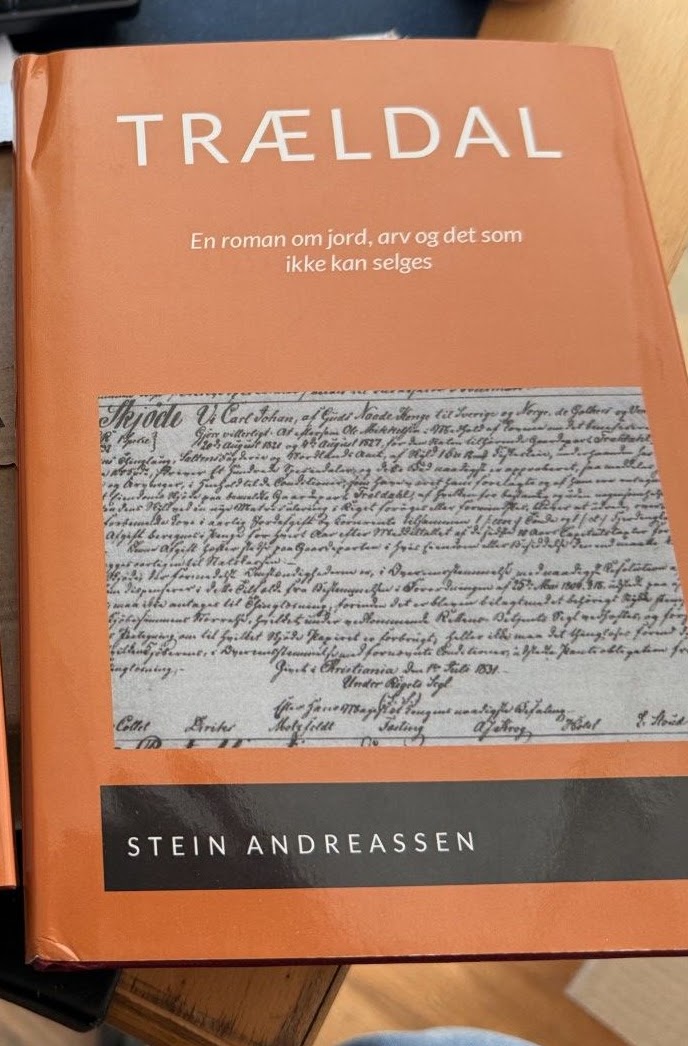
Trældal
A novel about land, heritage, and what cannot be sold
What if the ground you walk on could tell its own story?
Trældal is a historical novel inspired by the real people who lived on the Trældal farm for nearly two hundred years.
The story begins before 1831, when the farm still belonged to King Karl Johan and the family lived as tenant farmers – people who worked the land without owning it. Through toil, adversity and indomitable will, my great-great- grandfather managed to save up the enormous sum of 100 speciedaler and buy the farm. Thus began a family history that stretches all the way to the present day, where my sister Birte represents the seventh generation of owners.
From local history book to novel
The book actually began as an entirely different project. The goal was to document the farm’s history through a local history book of facts, documents and a family tree. As I dug my way into archives, old letters and family stories, a new question emerged:
What was life really like for the people behind the names?
That question became the beginning of the novel Trældal. The novel is built on real people, documented events and local history. Their lives, the conversations around the kitchen table, the love, the grief and the small moments between the historical facts are recreated through the author’s imagination – as history may have been.
Trældal is therefore not merely the story of one farm. It is the story of people who fought for their home, of generations who built upon what they inherited, and of how one small place by the Rombaksfjord mirrors the development of Norway across nearly 200 years.
Pre-order
The first proof print was really only meant as a test. But before I could bring it home, it was already sold. The response surprised me – nearly everyone asked the same question: “When can I buy it?”
You can now pre-order the first print run. When the pre-order period is over, I will send the book to print, and it will be shipped to you as soon as the first print run is ready.
Introductory price
Pre-order
Pre-order now – shipped as soon as the first print run is ready.
Excerpt from the book
Here you can read a sample and get a sense of what you’ll get:
Interlude: Rombaksbotn (1900)
Elias is nineteen when his father takes him to Rombaksbotn. They row before daybreak. The boat is loaded with timber. Logs Nils felled over the winter. Slow-grown pine. What the navvies need for their barracks. “Keep it steady,” Nils says. “We’ve a good way to go.” Elias rows. His arm feels the weight of the load. The boat sits low.
But the sea is glassy. They make headway. He has heard of Rombaksbotn. Everyone has heard of it. The town that grew up out of nothing. Hundreds of men. Hotels. Shops. Things no one believed could exist so far inside the fjord. But hearing and seeing are two different things. Already from a distance he sees the smoke. Ten, fifteen chimneys. Perhaps more. Black against the morning sky. Then the sound. Hammering. Sawing. Shouts in Swedish and Norwegian and languages he does not know. A soda factory bubbling. Horses whinnying. A hundred sounds blending into a single chaos of life. They round the point. And there lies the town. Elias has never seen the like. House upon house along the main street that runs straight through. Shops with signs he has to spell his way through. Hotel Northern. Hansen & Co. General Store. A bakery. Barracks in rows up the hillside. And the people. Everywhere. Navvies in worn trousers and heavy boots. Women in dresses that do not belong in the mountains. Children running between the houses. Two policemen in uniform on patrol. Only two farms stood here before. Now hundreds live here. Five or six hundred at most, people say. “Good God,” Elias whispers. Nils says nothing. Just rows the last stretch in to the quay. Moors. Lifts the first log up. “Lend a hand,” he says curtly.
A man meets them on the quay. A beard covering half his face. An accent Elias cannot place. Swedish perhaps. Or Finnish. “Nils Trældal?” the man asks. “The same.” “Have you the timber?” “Nine logs. Slow-grown pine, as agreed.” The man takes hold of one of the logs. Tests the weight. Looks at the growth rings on the end. “Good quality.” “Yes.” “Thirty kroner, as we said?” “Thirty.” They carry the timber up. Elias and his father at one end. The navvy and another man at the other. Heavy. Tough-grown wood that has stood in northern Norwegian weather for fifty years. They stack it by a house under construction. Only a frame so far. Logs that will become walls. “For four men,” the navvy says. “If we get it finished before the frost.” “Will you?” Nils asks. The man looks at the sky. Grey. Wind from the north. “Maybe,” he says. “If not, we’ll drink our way through the winter in the barrack.” He laughs. Hoarse and short. Like a bark. Nils gets the money. Counts it. Nods. “We need ice for home,” he says to Elias. “Wait here. I’m going to the general store.”
And then Elias is alone. Nineteen years old. His first time in Rombaksbotn. His first time in a town that really should not exist. He walks. Does not quite know where. Just walks. The main street is full of people. A man with leather boots up to his thigh comes out of the hotel. Swings himself up onto a horse too fine to be here. Behind the window Elias sees women. Heavy makeup. Dresses in colours that do not exist in nature. Two men fighting in the street. People walk around them as if it is not happening. As if it were rain. A policeman stares for a long while before he goes over and pulls them apart. At the bakehouse the queue runs out into the street. The smell of fresh-baked bread sets his stomach growling.
And then he hears it. First a low, deep thudding. Like distant thunder. Then a shriek. High and metallic. Elias stops. Listens. The train. It comes from the east. From the Swedish side. From the railway line that runs along the mountain, high above the valley. He looks up. Glimpses the smoke. The black steam rising toward the sky. And then he sees it. Just a flash between the trees. The locomotive hauling wagons westward. Toward Victoriahavn. Black. Enormous. Like a living creature that breathes and thunders. It vanishes behind the ridge. The sound fades. But the echo hangs in the air. Elias stands as if nailed fast. Looking where it disappeared. At the column of smoke still rising. He looks at the path. The narrow path that climbs up from the town. Up toward the railway line. Up toward what he just saw. His father is at the general store. Elias is to wait. But … He starts to walk. Up. Just to look closer. Just to see where the line runs. The path is steeper than he thought. First between the houses on the edge of town. Barracks where navvies live. Then out of the town. Into the forest. Logs and stone. Up. Always up. He stops thinking about the time. Stops thinking about his father. Just walks. After thirty minutes – perhaps more – he reaches the top.
The railway line lies there before him. The rails shine in the sunlight. Sleepers of creosoted timber. Ballast between them. Everything so new it almost has a smell. He goes over. Lays his hand on the rail. Cold. Smooth. So new it almost gleams. And then he hears it again. Thudding. Nearer now. Stronger. He turns to the east. Toward Sweden. The locomotive comes round the bend. A hundred metres away. Perhaps less. Elias stands perfectly still. Watches it come. The steam pouring out. The wheels turning. The steel rods pushing and pulling. And the fireman standing on the footplate, black with soot, who sees Elias and raises his hand. A greeting. An acknowledgement. The train passes. Wagon after wagon. Flat wagons with rails. Timber wagons with sleepers. Everything needed to build the line further westward. Toward Victoriahavn. Toward the ice-free harbour they are about to reach. Then it is gone. Only the sound lingers. Echoes between the mountains. Elias stands alone on the railway line. His hands trembling. His heart hammering. He looks east. Toward Sweden. Toward the mines in Kiruna where the ore waits. And west. Toward Victoriahavn where the ships will load. And he stands in between. On the line that will bind them together.
“There you are.” Nils’ voice is flat. Not angry. Just stating a fact. Elias turns. His father stands ten metres away. Breathing heavily. He has clearly walked fast. “I was just …” Elias begins. “I know what you were just,” Nils says. “I saw you go. Waited ten minutes. Then twenty. Then I came after.” He comes closer. Looks at his son. At the face that still bears the mark of what he saw. “It took you thirty minutes to come up,” Nils says. “And it takes thirty down. That is over an hour you have used.” “Sorry.” “The ice is melting in the boat. And we will have the tide against us in three hours.” Elias nods. Knows he has done wrong. Knows his father is right. But he cannot help looking toward the railway again. Toward the rails that vanish up the valley. Nils follows his gaze. Sees what his son sees. And perhaps he understands something then. Something important. “You saw the train?” he asks at last. “Yes.” “Up close?” “Yes.” They stand there. Father and son. The one who has seen. The other who understands.
“Come,” Nils says at last. “We have to get down before the ice melts entirely.” They start to walk. Down the steep path. Down toward the town. Down toward the boat that waits. But before they reach the first house, Nils stops. “The railway needs people,” he says. “When it opens. Engine drivers and maintenance men.” Elias says nothing. “You could apply,” Nils continues. “When the time comes.” Elias meets his father’s gaze. Sees something there. Permission. Understanding. Perhaps even approval. “But now,” Nils says, “we have to row home. Before the ice melts and the tide turns.”
They walk on. Down to the town. To the boat. To what awaits. But something has been said. Something important. And they both know it. On the way home they row in silence. Rombaksbotn disappears behind the point. The noise dies down. Only the sound of oars in the rowlocks, water against the bow, the gulls screaming over the fjord. Nils looks at his son. At the hands holding the oars. Steady and sure. The same hands that will take over the farm when he himself is gone. But perhaps also hands that will hold the levers of a locomotive. “Do you know why they are building the railway?” he asks at last. Elias looks up. “For the ore?” “Yes. But not our ore. Swedish ore. From Kiruna.” “Why must they carry it here?” Nils rows a few strokes before he answers. As if considering how to explain. “They have a railway to Luleå,” he says. “To the Gulf of Bothnia. But there the sea freezes in winter. Six months. The ships cannot sail. The ore lies waiting.” He points out across the fjord. Toward the sea. “But here it never freezes. The Gulf Stream. Warm water from the south. Victoriahavn is open all year. The ships can load every day. Every night. Even in January.” Elias looks out. At the moving water. At the fjord that never turns to ice. “So that is why?” he says quietly. “That is why. All year the ore ships can sail to Europe. To Germany. To England. All year the Swedes can sell their ore.” “And we build the railway for them.” “We build. They pay. And when it is finished, there will be ten, twelve trains a day. Three hundred tonnes in each. Ore trains from Kiruna to Victoriahavn. Year round. Round the clock.” “What are they called?” Elias asks suddenly. “The locomotives?” Nils looks at him. Rows a few strokes. “They have names,” he says. “Norse names from the sagas. Odin. Thor. And Bifrost.”
“Bifrost?” “The bridge between earth and heaven in the old tales. The rainbow bridge the gods walked across.” Elias thinks about it. About the name. About what it means. “A bridge,” he says quietly. “Yes. A bridge of steel and steam. Between the ore in the mountain and the ships in the harbour. Between Sweden and the world.” Elias rows. Thinks about what he saw. About the locomotive that came from the east. About the wagons. About the rails that will soon reach all the way to the harbour. Bifrost. The bridge between earth and heaven. Now a bridge of iron. All year round. Ore trains round the clock. Winter and summer. From the mines in Sweden to the ships at Victoriahavn. It is not just a railway. It is a miracle of steel and steam that will make the impossible possible. “It is hard work,” Nils says at last. “Yes.” “The railway will own you. Every morning. Every evening. When the snow comes. When the darkness comes.” “I know.” “But the farm has to have someone too. The cow must be milked. The field must be ploughed.” Elias rows on. Looks at the water. At Trældal appearing up ahead. At the farm he has known all his life. “I can row,” he says quietly. “Every morning. Milk before work. Row back in the evening.” Nils looks at him. At his son’s face. At the resolve that lies there. “It is a long way to row.”
“Yes.” “Every day. In all kinds of weather.” “Yes.” They say no more. But both of them know it. Elias has made up his mind. And when a man has made up his mind, there is nothing to do but follow the road. Two years later the Ofoten Line opens. 15 November 1902. And Elias stands on the platform in Narvik with the papers in his hand. Employed. A fireman first. Then an engine driver. Finally the driver of Bifrost – the locomotive from 1882. The oldest. The heaviest. The one that hauls the ore through snow and cold and northern Norwegian winter. But every morning, for forty years, he will row across the fjord first. Milk the cow. Plough the field. Keep the farm going.
For he is a railwayman. But he is also a Trældal man.
And both of these he remains until his death.